
5 September 2026 · 13 min read
Yoga for Cyclists: Stretches for Mobility and Recovery
By Pure Lifestyle Yoga. Reviewed by Subham Jha, Senior Yoga Instructor.
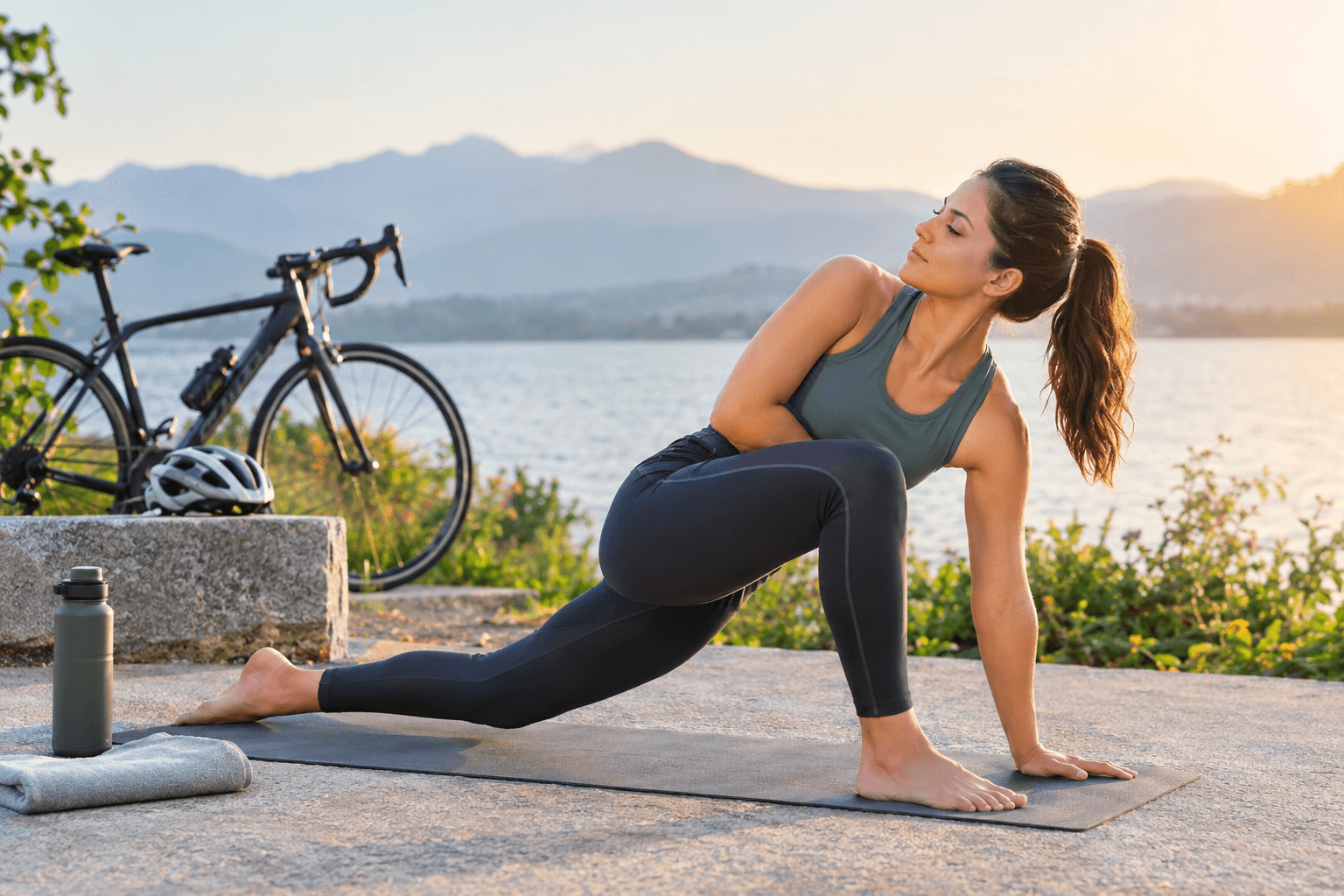
Cycling is an excellent way to improve cardiovascular fitness, build lower-body endurance, and enjoy the outdoors. However, spending long hours on a bicycle can leave your hips tight, hamstrings stiff, shoulders tense, and lower back uncomfortable. Whether you are a beginner, a daily commuter, or an experienced cyclist, adding yoga to your routine can help you move more comfortably and support your overall recovery.
Yoga for cyclists combines gentle stretching, controlled breathing, balance, and mobility exercises to complement regular cycling. A consistent yoga practice can help maintain flexibility, improve body awareness, and provide a relaxing way to unwind after a long ride.
At Pure Lifestyle Yoga, we believe that movement should support your lifestyle. In this guide, you will discover some of the best yoga poses for cyclists, how to practise them safely, and how to build a simple routine around your riding schedule.
Why Is Yoga Beneficial for Cyclists?
Cycling involves repetitive leg movements while the body often remains in a forward-leaning position. Over time, this can contribute to tightness in the hip flexors, quadriceps, calves, hamstrings, chest, and shoulders.
Yoga offers a complementary form of movement that focuses on areas that may receive less varied movement during cycling.
1. Supports Hip Mobility
During cycling, the hips repeatedly bend and straighten. Spending extended periods in this position may contribute to tightness around the hip flexors. Yoga poses that gently open the front of the hips can help maintain comfortable movement.
2. Helps Maintain Hamstring and Calf Flexibility
The hamstrings and calves contribute to lower-body movement and stability. Gentle stretching can help maintain their flexibility and make everyday movement feel more comfortable.
3. Encourages Better Posture and Body Awareness
Cyclists often lean forward over the handlebars, which can place sustained demands on the back, neck, and shoulders. Yoga poses that encourage spinal mobility, chest opening, and balanced muscular engagement can complement cycling posture.
4. Supports Relaxation After Long Rides
Slow breathing and restorative yoga can help you relax after physically demanding activity. A calming routine may also make it easier to transition from training to rest.
5. Complements Recovery and Mobility Training
Yoga can be part of an overall recovery plan that includes adequate sleep, hydration, balanced nutrition, and appropriate rest between rides. It is not a substitute for rest or medical treatment, but it can be a valuable addition to a cyclist's fitness routine.
Best Yoga Poses for Cyclists
The following poses target common areas of tightness associated with cycling. Practise them slowly, breathe naturally, and avoid forcing your body into a deeper stretch.
1. Low Lunge (Anjaneyasana)
Best for: Hip flexors and the front of the thighs.
The Low Lunge is particularly useful for cyclists who spend several hours with their hips flexed while riding.
How to practise:
Begin in a kneeling position on a yoga mat.
Step your right foot forward, placing it flat on the floor.
Position your right knee approximately above your ankle.
Gently move your hips forward until you feel a comfortable stretch at the front of your left hip.
Keep your torso upright and your shoulders relaxed.
Hold for 20–30 seconds while breathing slowly.
Switch sides and repeat.
Tip: Place a folded blanket under your back knee if you need additional cushioning. Avoid pushing your hips forward aggressively.
2. Downward-Facing Dog (Adho Mukha Svanasana)
Best for: Calves, hamstrings, shoulders, and overall body mobility.
Downward-Facing Dog is a familiar yoga pose that gently stretches the back of the legs while encouraging shoulder and spinal lengthening.
How to practise:
Start on your hands and knees.
Spread your fingers and press your palms into the mat.
Tuck your toes and lift your hips upward and backward.
Keep your spine long and bend your knees slightly if your hamstrings feel tight.
Allow your head to relax between your upper arms without straining your neck.
Hold for 20–40 seconds, breathing comfortably.
Tip: Your heels do not need to touch the floor. Prioritise a comfortable, lengthened spine over straightening your legs.
3. Low Lunge with a Quadriceps Stretch
Best for: Quadriceps and hip flexors.
The quadriceps work repeatedly during cycling. A gentle variation of Low Lunge can target the front of the thigh, particularly after a long ride.
How to practise:
Begin in a Low Lunge with your right foot forward and left knee resting on a padded surface.
Keep your torso upright and your hips stable.
If comfortable, bend your left knee and gently bring your left heel toward your body.
Hold your foot only if you can do so without twisting or straining.
Maintain a gentle stretch for 15–25 seconds.
Release slowly and switch sides.
Tip: Skip the foot-holding variation if it causes knee discomfort. A standard Low Lunge is an effective alternative.
4. Reclining Hand-to-Big-Toe Pose (Supta Padangusthasana)
Best for: Hamstrings and the back of the legs.
This reclining stretch allows you to work on hamstring flexibility without placing much weight on your joints.
How to practise:
Lie on your back with both legs extended.
Bring your right knee toward your chest.
Hold the back of your thigh or use a yoga strap around your foot.
Slowly extend your right leg upward as far as is comfortable.
Keep your opposite leg relaxed on the mat.
Hold for 20–30 seconds and breathe naturally.
Repeat on the other side.
Tip: Keep a slight bend in your raised knee if your hamstrings feel tight. Do not pull the leg toward your face.
5. Figure-Four Stretch
Best for: Glutes and the outer hips.
Cyclists may experience tightness around the gluteal muscles and outer hips. The Figure-Four Stretch offers a gentle way to target this area.
How to practise:
Lie on your back with your knees bent and feet on the floor.
Place your right ankle over your left thigh, just above the knee.
Keep your right foot gently flexed.
If comfortable, lift your left foot and hold the back of your left thigh.
Bring your legs slightly closer to your torso until you feel a gentle stretch in your right hip.
Hold for 20–30 seconds.
Release and repeat on the opposite side.
Tip: Avoid pushing directly on your knee. If the position causes discomfort, keep your supporting foot on the floor.
6. Cat-Cow Pose (Marjaryasana-Bitilasana)
Best for: Gentle spinal mobility and back movement.
Cat-Cow is a simple movement sequence that helps you explore comfortable spinal flexion and extension after maintaining a relatively fixed position on the bicycle.
How to practise:
Begin on all fours with your hands beneath your shoulders and knees beneath your hips.
Inhale and gently lift your chest while allowing your abdomen to soften.
Exhale and round your spine, drawing your abdomen inward.
Move slowly between the two positions.
Repeat for 8–10 comfortable cycles.
Tip: Let your spine move naturally and avoid forcing your neck into either direction.
7. Child's Pose (Balasana)
Best for: Relaxation, gentle back stretching, and releasing tension.
Child's Pose is a restorative posture that can help you slow down after exercise.
How to practise:
Kneel on your mat and bring your big toes toward each other.
Separate your knees to a comfortable width.
Slowly move your hips toward your heels.
Extend your arms forward or rest them alongside your body.
Allow your forehead to rest on the mat or a cushion.
Stay for 30–60 seconds while breathing gently.
Tip: Place a bolster or pillow beneath your chest, or between your thighs and calves, if needed. Choose another comfortable position if kneeling bothers your knees.
8. Bridge Pose (Setu Bandhasana)
Best for: Gluteal muscles, hip extension, and controlled trunk engagement.
Cycling primarily involves repetitive movement in a flexed-hip position. Bridge Pose introduces a different movement pattern by encouraging gentle hip extension.
How to practise:
Lie on your back with your knees bent and feet hip-width apart.
Keep your arms alongside your body with palms facing down.
Press gently through your feet.
Lift your hips until your shoulders, hips, and knees form a comfortable diagonal line.
Keep your knees pointing forward and avoid flaring your ribs.
Hold for 15–30 seconds while breathing normally.
Lower your spine slowly.
Tip: Focus on controlled movement rather than lifting your hips as high as possible. Stop if you experience back pain.
9. Supine Spinal Twist
Best for: Gentle spinal rotation and relaxation.
A gentle reclining twist introduces rotational movement after the relatively repetitive forward-facing position of cycling.
How to practise:
Lie on your back with your knees bent.
Extend your arms out to the sides.
Slowly lower both knees toward your right side.
Keep your shoulders relaxed and supported by the floor as comfortably as possible.
Turn your head only if doing so feels comfortable.
Hold for 20–30 seconds.
Return to the centre and repeat on the left.
Tip: Place a cushion beneath your knees for support. Keep the twist gentle rather than pushing your knees toward the floor.
10. Legs-Up-the-Wall Pose (Viparita Karani)
Best for: Relaxation after a long ride.
Legs-Up-the-Wall is a restorative posture that offers a quiet opportunity to relax after physical activity.
How to practise:
Sit sideways beside a wall.
Gently lower your torso onto the floor as you bring your legs up the wall.
Adjust your distance from the wall until your legs feel comfortable.
Rest your arms by your sides.
Relax your shoulders and breathe naturally.
Stay for 2–5 minutes, provided the position feels comfortable.
Tip: Place a folded blanket beneath your head if desired. Come out slowly, especially if you feel light-headed. Avoid this position if it aggravates a medical condition or causes discomfort.
A Simple 10–15 Minute Yoga Routine for Cyclists
You do not need to practise every yoga pose daily. A short, consistent routine can be easier to maintain than a long session.
Here is a simple sequence to try after an easy ride or as part of your general mobility routine.
Yoga poseSuggested durationCat-Cow Pose1 minuteDownward-Facing Dog30–40 secondsLow Lunge — right side30 secondsLow Lunge — left side30 secondsReclining Hamstring Stretch30 seconds per sideFigure-Four Stretch30 seconds per sideBridge Pose3–5 slow repetitionsChild's Pose1 minuteLegs-Up-the-Wall Pose2–3 minutes
Move at a comfortable pace and adjust the sequence to suit your needs. The routine may take approximately 10–15 minutes, depending on transitions and rest periods.
When Should Cyclists Practise Yoga?
The best time to practise depends on your ride intensity, recovery needs, and personal schedule.
Before Cycling
Before a ride, choose dynamic movements rather than long, intense static stretches. Gentle Cat-Cow movements, controlled leg swings, easy walking, and light hip mobility can help prepare your body for activity.
Yoga should complement a cycling-specific warm-up, not replace it entirely.
After Cycling
After an easy or moderate ride, gentle static stretches can be a comfortable way to unwind. Focus on the hips, quadriceps, hamstrings, calves, and back.
After a very intense ride, allow your breathing and heart rate to settle first. Keep stretches mild, particularly if your muscles feel fatigued.
On Rest Days
Rest days are a useful opportunity to practise a longer, gentle yoga session. You can focus on mobility, balance, breathing, and relaxation without adding unnecessary training intensity.
Remember that recovery also requires sufficient sleep, nutrition, hydration, and appropriate rest.
Tips to Make Yoga More Effective for Cyclists
To get the most from your yoga practice, keep these recommendations in mind:
Start gently: Choose beginner-friendly variations and increase your range of movement gradually.
Breathe naturally: Avoid holding your breath or forcing yourself into a deeper stretch.
Prioritise consistency: Short sessions practised regularly may be easier to sustain than occasional intensive sessions.
Use yoga props: Blocks, straps, cushions, and folded blankets can make poses more accessible.
Respect your recovery: Avoid intense stretching when your muscles are severely fatigued or unusually sore.
Maintain a balanced routine: Combine yoga with suitable strength training, cycling technique, adequate nutrition, and rest.
Review your bike fit: Persistent discomfort during riding may relate to saddle height, handlebar position, training load, or another issue that yoga alone will not resolve.
Common Yoga Mistakes Cyclists Should Avoid
Even gentle yoga can become uncomfortable if poses are performed without attention to alignment and individual limitations.
1. Forcing a Deep Stretch
A stronger stretch is not necessarily a better stretch. Stay within a comfortable range and never bounce or force a joint into position.
2. Ignoring Knee Discomfort
Some hip-opening and kneeling poses can place pressure on the knees. Use cushioning, modify the pose, or choose an alternative if discomfort occurs.
3. Stretching Aggressively After a Hard Ride
Intense exercise can leave muscles fatigued and temporarily more sensitive. Choose gentle movements and avoid pushing for maximum flexibility immediately after strenuous training.
4. Expecting Yoga to Fix Every Cycling Problem
Yoga can support mobility and relaxation, but it cannot correct every cause of pain or poor cycling mechanics. Persistent symptoms may require professional assessment.
5. Skipping Rest and Recovery
Yoga is one part of a balanced training plan. Adequate sleep, nutrition, hydration, and rest are equally important.
Safety Precautions Before Starting Yoga
Most healthy adults can adapt gentle yoga to their abilities, but not every pose is appropriate for every person.
Stop if a movement causes sharp pain, numbness, tingling, or worsening symptoms.
If you have a recent injury, significant joint problems, or a medical condition affecting movement, seek advice from an appropriate healthcare professional before starting.
If you experience persistent back, hip, knee, or neck pain, consult a qualified healthcare professional rather than relying on stretching alone.
Never use yoga as a substitute for medical evaluation of unexplained or severe symptoms.
Yoga should feel controlled and manageable. You do not need to achieve a perfect pose to benefit from the practice.
Frequently Asked Questions (FAQs)
1. Is yoga good for cyclists?
Yoga can complement cycling by supporting flexibility, mobility, balance, body awareness, and relaxation. Its benefits depend on the poses, frequency, and individual needs of the cyclist.
2. Which yoga poses are best for cyclists?
Low Lunge, Downward-Facing Dog, Figure-Four Stretch, Reclining Hand-to-Big-Toe Pose, Cat-Cow, and Bridge Pose are useful options for addressing common areas of tightness and movement restrictions.
3. How often should cyclists practise yoga?
Many cyclists can begin with two or three short sessions per week and adjust according to their training schedule and recovery needs. Even a brief routine can be a practical starting point.
4. Should I do yoga before or after cycling?
Gentle dynamic movements are generally more appropriate before cycling, while comfortable static stretches and restorative poses can be useful after an easy or moderate ride. Avoid aggressive stretching when fatigued.
5. Can yoga help with tight hip flexors from cycling?
Gentle hip-extension movements, such as Low Lunge, may help maintain comfortable hip mobility. Persistent tightness or pain may require changes to training, bike fit, or professional assessment.
6. Can beginners practise yoga for cycling?
Yes. Beginners can start with supported versions of simple poses, use yoga props, and focus on comfortable movement rather than flexibility or advanced positions.
7. Does yoga improve cycling performance?
Yoga may support mobility, balance, body awareness, and recovery habits, but it does not automatically improve speed, endurance, or power. Cycling-specific training remains essential for developing those qualities.
Conclusion
Cycling keeps you moving, builds endurance, and can be an enjoyable part of a healthy lifestyle. Adding yoga to your weekly schedule offers an opportunity to balance repetitive riding movements with gentle stretching, mobility work, controlled breathing, and relaxation.
From Low Lunge and Downward-Facing Dog to Figure-Four Stretch and Legs-Up-the-Wall, these yoga poses for cyclists can help you build a routine that fits your needs and experience level.
At Pure Lifestyle Yoga, we encourage you to listen to your body, practise consistently, and approach every session with patience. Whether you cycle for fitness, commuting, recreation, or competition, a mindful yoga practice can become a valuable part of your overall wellness routine.
Ready to bring more balance to your cycling routine? Explore yoga practices that fit your lifestyle and make time for movement, mindful breathing, and recovery.
This article is general information about yoga practice, not medical advice. If you have a health condition or an injury, or you are pregnant, please speak to your doctor before beginning and tell your teacher.
Would you like a teacher to guide you? See yoga for back and neck stiffness with Pure Lifestyle Yoga.
Enjoy writing like this?
Considered pieces on practice and wellbeing — never a marketing blast.