

9 August 2026 · 6 min read
Why Personalised Private Yoga Is Becoming the Future of Modern Wellness
By pure Lifestyle Yoga
Real Problem: Why Is It So Difficult to Maintain a Yoga Practice?
Most people don't struggle because they don't understand the benefits of yoga.
They struggle because their lifestyle doesn't fit a one-size-fits-all routine.
A professional may spend eight to ten hours sitting at a desk. Someone who travels frequently may struggle with consistency. A beginner may not know whether a particular posture is suitable for their body. Someone recovering from physical discomfort may be unsure about which movements to practice.
Then there is another problem:
Generic yoga routines don't always address individual needs.
Your body, experience, mobility, schedule and wellness goals are different from someone else's.
This raises an important question:
What if your yoga practice was designed around you instead of asking you to adapt to a fixed class?
That is where personalised private yoga becomes valuable.
Useful Information: What Is Personalised Private Yoga?
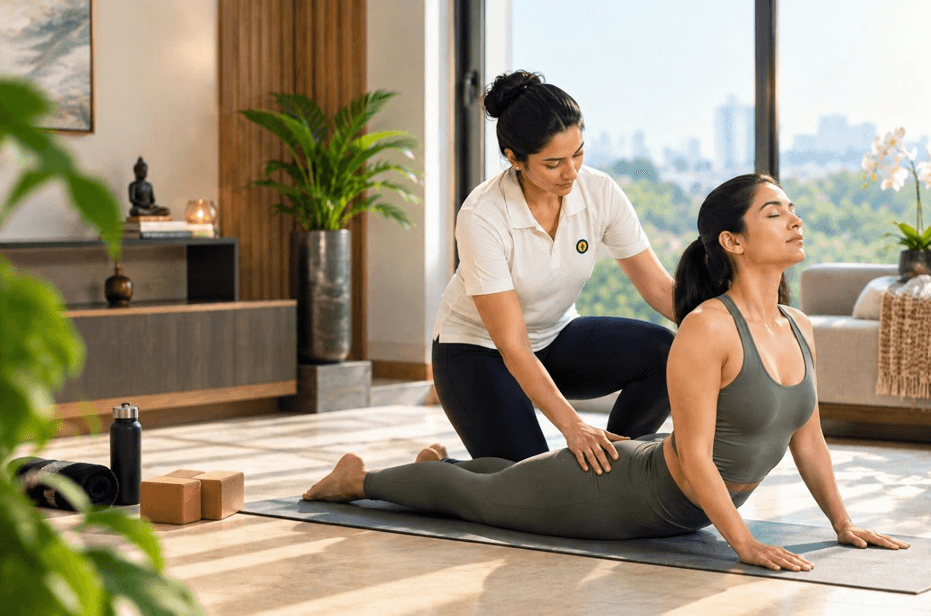
Personalised private yoga is a one-to-one yoga experience where the practice is adapted according to the individual's goals, lifestyle, experience and physical requirements.
Instead of simply following a predefined sequence, the instructor can focus more closely on:
• Movement quality
• Postural awareness
• Breathing
• Mobility
• Flexibility
• Strength and stability
• Relaxation
• Individual goals
• Lifestyle requirements
The objective isn't necessarily to perform advanced yoga poses. The objective is to create a consistent and appropriate practice that you can realistically maintain.
Evidence & Expertise: Why Personalisation Matters Yoga involves much more than simply moving the body from one position to another.
A thoughtful practice considers alignment, breathing, movement patterns and individual limitations.
For example, two people may both experience stiffness after working at a desk, but their movement patterns may be completely different.
One person may have limited hip mobility.
Another may have restricted shoulder movement.
Someone else may simply need a more structured movement and relaxation routine.
This is why personalised instruction can be more useful than assuming that one sequence works equally well for everyone.
1. Alignment Matters
Good yoga instruction pays attention to how a person moves into and out of a posture rather than focusing only on how the final pose looks.
Small adjustments can make a practice more controlled and purposeful.
2. Breathing Is Part of the Practice
Breath can be consciously coordinated with movement. Instead of treating breathing as an optional addition, a personalised practice can use breath awareness to make sessions more mindful and controlled.
3. Your Lifestyle Influences Your Practice
Your daily routine matters.
Someone working long hours at a desk may need a different emphasis from someone who spends most of the day physically active.
Similarly, a frequent traveller may need a routine that can be adapted to different environments.
Personalisation makes the practice relevant to the person—not just the pose.
Practical Tips: How to Build a Better Yoga Routine
You don't need to completely change your lifestyle to begin practising yoga.
Start by making the practice realistic.
Tip 1: Identify Your Primary Goal
Don't begin with:
"I want to do yoga."
Begin with:
"What do I want yoga to help me work on?"
Your goal might be:
• Better mobility
• Improved posture
• Stress management
• Greater body awareness
• Flexibility
• Strength
• Relaxation
• Building a consistent wellness routine
A clear goal makes it easier to structure your practice.
Tip 2: Start With Your Current Ability
Don't compare your body with someone else's.
Yoga isn't a competition.
If you're a beginner, start with foundational movements. If you already practise yoga, focus on improving control, breathing and awareness rather than simply increasing difficulty.
Tip 3: Make Consistency More Important Than Intensity
A short, consistent practice can be easier to maintain than an extremely demanding routine that you only do occasionally.
Instead of asking:
"How advanced is my yoga?"
Ask:
"Can I maintain this practice?"
Tip 4: Consider Your Daily Routine
Your yoga practice should complement your lifestyle.
If you spend most of your day sitting, consider incorporating movement that addresses areas commonly affected by prolonged sitting.
If your work involves frequent travel, consider a routine that doesn't depend on having a large studio or extensive equipment.
Tip 5: Work With a Qualified Instructor When You Need Individual Guidance
If you are new to yoga, have specific physical concerns or simply want a structured practice, one-to-one instruction can provide more individual attention than a large group class.
For persistent pain, injury or a medical condition, appropriate healthcare guidance should come first.
Common Mistakes People Make With Yoga
Even with the best intentions, several mistakes can make a yoga practice difficult to maintain.
Mistake 1: Copying Someone Else's Routine
A routine that works beautifully for another person may not be appropriate for you.
Better approach: Understand your own goals and limitations.
Mistake 2: Focusing Only on Flexibility
Many people think yoga means becoming flexible.
But yoga can also involve:
• Mobility
• Stability
• Strength
• Balance
• Breathing
• Awareness
• Relaxation
Flexibility is only one part of the picture.
Mistake 3: Forcing a Pose
Going deeper isn't automatically better.
Trying to force your body into a posture can compromise control and comfort.
Better approach: Prioritise controlled movement and appropriate alignment.
Mistake 4: Ignoring Breathing
Holding your breath while concentrating on a difficult posture can take away from the mindful nature of the practice.
Keep breathing naturally and consciously.
Mistake 5: Choosing a Routine That Doesn't Fit Your Life
If your yoga schedule constantly conflicts with work, family or travel, consistency becomes difficult.
Better approach: Build the practice around your actual lifestyle.
FAQ: Personalised Private Yoga
Is private yoga suitable for beginners?
Yes. In fact, personalised instruction can be particularly useful for beginners because the practice can be introduced according to their experience and comfort level.
Is private yoga only for advanced practitioners?
No. Private yoga can be designed for beginners as well as experienced practitioners. The focus is on individual goals rather than experience level.
Can private yoga help with posture?
A personalised yoga practice can include movement and alignment work that supports greater postural awareness. However, persistent pain or diagnosed conditions should be evaluated by an appropriate healthcare professional.
Can I do private yoga at home?
Yes. Private at-home sessions can be a convenient option for people who prefer privacy and don't want to travel to a studio.
What about online private yoga?
Live one-to-one online sessions can be useful for people who travel frequently or prefer practising from home.
How often should I practise yoga?
There isn't one universal answer. The ideal frequency depends on your goals, experience, schedule and overall routine. Consistency is generally more useful than creating an unrealistic schedule.
Do I need to be flexible before starting yoga?
No.
You don't need to become flexible before starting yoga. Yoga can be part of the process of developing greater mobility and body awareness.
A More Personal Approach to Wellness The future of wellness doesn't necessarily mean doing more.
It may mean doing what is appropriate for you.
Your work schedule is different.
Your body is different.
Your goals are different.
Your lifestyle is different.
So why should your yoga practice be exactly the same as everyone else's?
Personalised private yoga provides an opportunity to make the practice more intentional by bringing together movement, breathing, alignment, individual attention and lifestyle considerations.
The goal isn't to chase the most complicated posture.
The goal is to build a practice that supports your journey toward greater balance and wellbeing.
Enjoy writing like this?
Considered pieces on practice and wellbeing — never a marketing blast.