

6 June 2026 · 5 min read
The Science of the Shoulder
By Pure Lifestyle Yoga
Introduction: The Posture Problem Hiding in Plain Sight
Walk into any office, café, or living room today and you will see the same silhouette repeated: shoulders drawn forward, chest slightly caved, chin inching toward the screen. Rounded shoulder posture has become so common that it is often mistaken for normal. It is not. It is a measurable, correctable pattern of musculoskeletal imbalance — and understanding its biomechanics is the first step toward reversing it.
Person exhibiting rounded shoulder posture while working at a desk
At Pure Lifestyle Yoga, we treat posture correction as an applied science rather than a wellness trend. Precision Asana — the deliberate, anatomically-informed use of yoga postures — offers a evidence-aligned path to restoring shoulder mobility, spinal alignment, and functional movement, without relying on generic stretching routines or one-size-fits-all classes.
Understanding Rounded Shoulder Posture: The Biomechanics
Rounded shoulder posture is not a single fault but a chain reaction across the shoulder girdle and spine. Clinically, it involves three coordinated changes:
- Scapular protraction and downward rotation — the shoulder blades drift forward and away from the spine.
- Internal rotation of the humerus — the upper arm bones turn inward, drawing the shoulders with them.
- Increased thoracic kyphosis — the mid-back rounds forward to compensate, straining spinal alignment further up and down the chain.
This pattern reflects a well-documented biomechanical imbalance sometimes described as an "upper crossed" pattern: the pectoralis major and minor, along with the upper trapezius and levator scapulae, become chronically shortened and overactive. Meanwhile, their opposing muscles — the rhomboids, middle and lower trapezius, and serratus anterior — weaken and lengthen. The result is a joint system pulled consistently in one direction, with little counter-tension to hold it upright.
Why This Matters
A shoulder joint is only as stable as the muscles pulling on it in opposing directions. When one side of that tug-of-war consistently wins, the joint's resting position shifts — and pain, restricted shoulder mobility, and nerve irritation often follow.
The Precision Asana Protocol for Shoulder Correction
The following postures form a foundational sequence used within Pure Lifestyle Yoga's private sessions. Each is selected for a specific biomechanical action rather than general flexibility.
AsTarget MusclesBiomechanical ActionCorrective Benefit
- Bhujangasana (Cobra Pose)
- Pectorals (lengthened), rhomboids & trapezius (activated)
- Thoracic extension with scapular retraction
- Opens the chest and reinforces an upright thoracic curve
- Marjaryasana–Bitilasana (Cat–Cow)
- Spinal erectors, deep neck flexors
- Segmental spinal mobilization
- Restores fluid mobility across the cervical–thoracic–lumbar chain
- Gomukhasana Arms (Cow-Face Arms)
- Rotator cuff, latissimus dorsi, pectorals
- Combined shoulder flexion and extension through full range
- Reveals and improves side-to-side shoulder mobility asymmetry
- Dhanurasana (Bow Pose)
- Full anterior chain (stretched), full posterior chain (activated)
- Simultaneous anterior lengthening and posterior strengthening
- Addresses the entire kinetic chain behind kyphotic posture
- Setu Bandhasana (Bridge Pose)
- Thoracic extensors, glutes, scapular retractors
- Posterior chain activation with shoulder retraction
- Builds the postural endurance needed to hold spinal alignment
- Supported Matsyasana (Restorative Fish)
- Pectoralis minor
- Passive, sustained myofascial release
- Long-duration corrective stretch
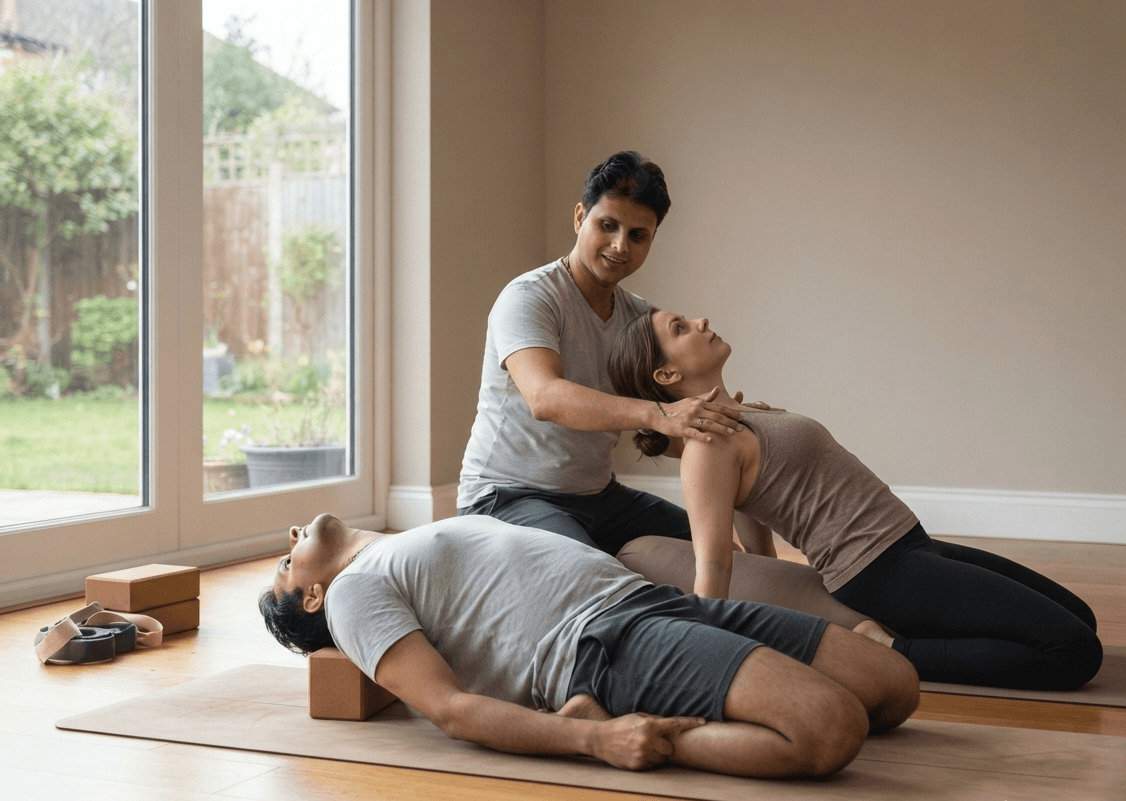
In private yoga therapy, every correction is calibrated to the individual's specific postural pattern.
Practical Takeaways for Everyday Posture Care
- Set a movement reminder every 45–60 minutes to counteract sustained forward-leaning postures.
- Prioritize posterior chain activation (rows, scapular retraction drills) alongside any chest-opening stretch.
- Treat shoulder mobility work as a daily practice, not an occasional fix — neuromuscular re-patterning takes consistency.
- Seek a professional assessment before self-prescribing intense backbends if you have existing shoulder pain or injury.
Why Precision-Based Private Yoga Is the Better Investment
Correcting rounded shoulder posture is ultimately a question of accurate diagnosis and precise, consistent input. Pure Lifestyle Yoga's private sessions are built around this principle: every asana is selected, sequenced, and adjusted around the individual's own biomechanics — not a standardized class plan. This is corrective yoga in its truest sense: a therapeutic application of movement science, delivered with the attentiveness of a private practice.
Frequently Asked Questions
How long does posture correction through yoga typically take?
Most practitioners notice improved shoulder mobility within a few weeks of consistent, guided practice, while deeper structural change in spinal alignment generally develops over several months.
Is yoga actually backed by science for posture correction, or is this just tradition?
The biomechanical principles involved — reciprocal lengthening and strengthening, proprioceptive retraining, multi-plane loading — are well established in physical therapy and movement science. Yoga applies these principles through specific asanas, which is why precision in posture matters more than the label "yoga" itself.
I already have shoulder pain. Is it safe to start these poses on my own?
Existing shoulder pain warrants a professional assessment before beginning any corrective sequence, particularly deeper backbends. A private, guided setting allows postures to be modified safely around your specific pain pattern.
What makes corrective yoga different from a regular yoga class?
Corrective yoga is chosen and sequenced around a specific structural goal — in this case, reversing rounded shoulder posture — rather than following a general flow. It relies on precise alignment cues and individual progress tracking, which is difficult to deliver in a group setting.
Conclusion: Posture Correction Is a Science — Treat It Like One
Rounded shoulder posture is not simply an aesthetic concern; it is a biomechanical pattern with a clear anatomical basis and a clear corrective pathway. Precision Asana offers that pathway — combining the lengthening, strengthening, and proprioceptive retraining that true shoulder mobility and spinal alignment require. What determines results is not the number of poses attempted, but the accuracy with which they are applied to your specific pattern.
That is the exact gap Pure Lifestyle Yoga's private, precision-based sessions are designed to close — beginning with an individual assessment and a corrective plan built around your body, not a generic class.
Enjoy writing like this?
Considered pieces on practice and wellbeing — never a marketing blast.