

19 May 2026 · 6 min read
The Anatomy of Alignment: Why Your Spine Decides Everything in Yoga
By Pure Lifestyle Yoga
Have you ever noticed how your body feels when you sit at a desk for hours or scroll through your phone for too long? The shoulders begin to round, the neck feels stiff, and the lower back may start to ache. Most of us have experienced this at some point, often without realizing that the spine is at the center of it all.
Your spine and body alignment are both essential for your posture, which matters in both your professional and personal life; for this, the correct anatomy of your spine is crucial.
The same principle applies in yoga. While it is easy to focus on how deep a stretch looks or how perfectly a pose appears from the outside, the real foundation of every posture is spinal alignment.
Think of the spine as the body’s central axis. It supports the head and torso, protects the nervous system, and helps the body move with balance and coordination. When the spine is aligned, yoga postures can feel more stable, comfortable, and energizing. When alignment is compromised, even a simple pose may create unnecessary strain.
At Pure Lifestyle Yoga, we believe that alignment is not about forcing the body into a rigid shape. It is about understanding how the body naturally functions and learning to move with awareness. By paying attention to the spine, practitioners can build a safer, more effective, and more sustainable yoga practice.
So before thinking about touching your toes or mastering an advanced pose, it is worth asking: how is your spine supporting your movement right now?
Understanding the Spine: The Body’s Central Axis
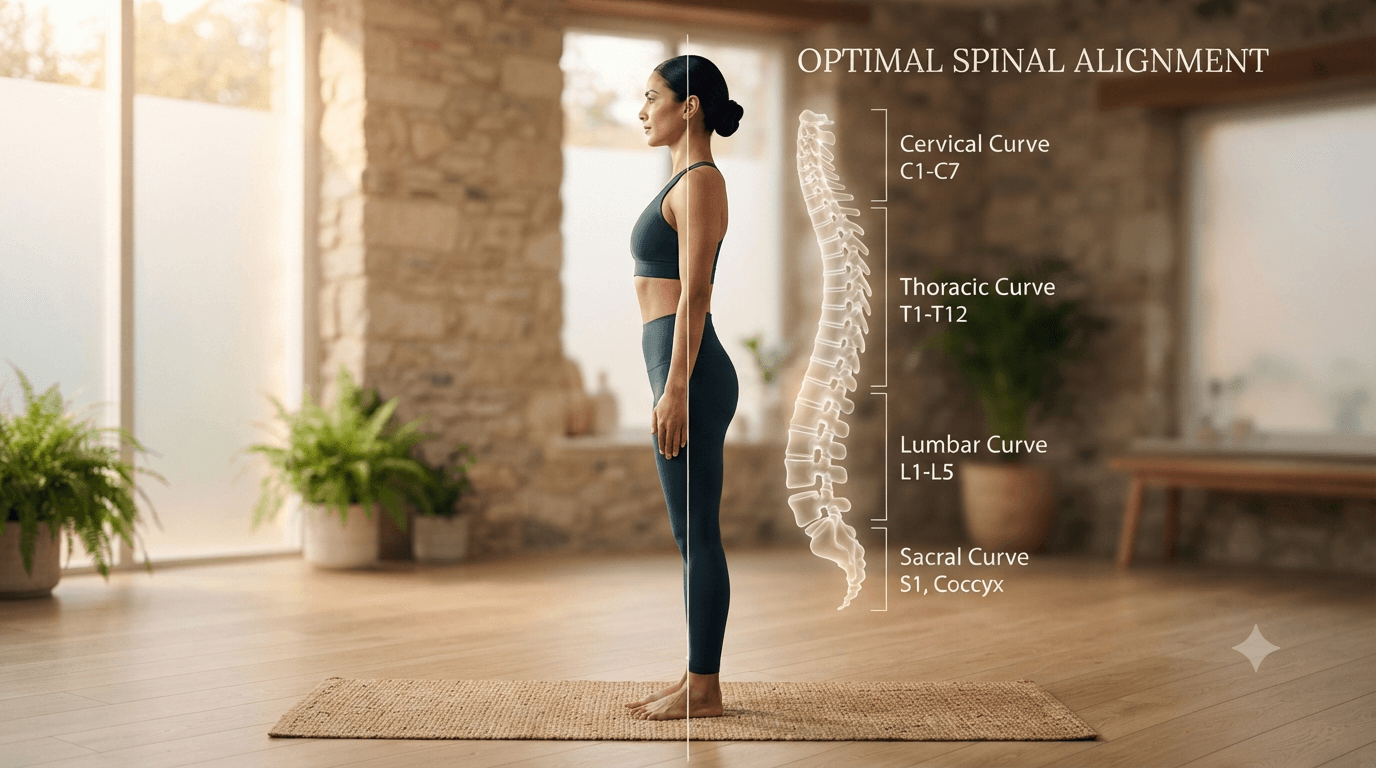
The human spine is composed of 33 vertebrae, arranged in five regions:
- Cervical spine: 7 vertebrae in the neck
- Thoracic spine: 12 vertebrae in the upper and mid-back
- Lumbar spine: 5 vertebrae in the lower back
- Sacrum: 5 fused vertebrae
- Coccyx: 4 fused vertebrae
These regions form natural curves that help the body distribute weight, absorb shock, and maintain balance. A healthy spine is not perfectly straight; rather, its gentle curves allow it to function as a flexible yet stable column.
The Spine’s Key Functions
- Structural support: It supports the head and torso while maintaining upright posture.
- Protection of the nervous system: The spinal cord runs through the vertebral column, carrying signals between the brain and body.
- Mobility: The spine enables bending, twisting, extension, and lateral movement.
- Balance and coordination: Proper spinal positioning helps the body maintain equilibrium during movement.
Why Spinal Alignment Matters in Yoga
In yoga, alignment refers to the relationship between different parts of the body during movement and stillness. Because the spine connects the head, ribcage, pelvis, and limbs, its alignment influences nearly every aspect of a posture.
Improves Stability
A well-aligned spine creates a stable foundation for standing, balancing, and seated postures. When the spine is centered and supported, the body can distribute weight more evenly, reducing unnecessary strain on muscles and joints.
Enhances Breathing
The thoracic spine and ribcage play a significant role in respiration. Slouching or collapsing through the chest can restrict lung expansion, while an elongated spine allows the diaphragm and ribcage to move more freely.
Reduces Risk of Injury
Misalignment can place excessive pressure on certain joints, discs, and muscles. For example, excessive rounding of the lower back in forward folds may increase strain on the lumbar spine. Proper alignment helps distribute forces more safely throughout the body.
Supports Efficient Movement
When the spine is aligned, muscles can work more efficiently. This means less wasted effort and greater ease in holding or transitioning between postures.
Promotes Nervous System Regulation
Because the spinal cord is housed within the vertebral column, spinal health is closely connected to nervous system function. Gentle, mindful spinal movement in yoga may support relaxation and reduce physical tension.
The Biomechanics of Common Yoga Movements
Forward Folds
In postures such as Uttanasana (Standing Forward Fold), the movement should ideally originate from the hips rather than excessive rounding of the lower back.
- Healthy alignment: Lengthen the spine and hinge from the hip joints.
- Common mistake: Collapsing through the lumbar spine to reach the floor.
Backbends
Backbends require spinal extension, but the movement should be distributed throughout the entire spine rather than concentrated only in the lower back.
- Healthy alignment: Engage the core, lift through the chest, and lengthen before bending backward.
- Common mistake: Compressing the lumbar spine by forcing the backbend.
Twists
Twisting postures involve rotation primarily through the thoracic spine, while the lumbar spine has a more limited rotational capacity.
- Healthy alignment: Lengthen the spine before rotating.
- Common mistake: Forcing the twist from the lower back.
Seated Postures
In seated poses, the relationship between the pelvis and spine is crucial. A tilted or collapsed pelvis can lead to rounding of the lower back.
- Healthy alignment: Sit on the sitting bones and maintain a natural spinal curve.
- Common mistake: Slumping through the chest and lower back.
Signs of Poor Spinal Alignment in Yoga
- Persistent lower back pain after practice
- Neck tension in standing or seated poses
- Difficulty maintaining balance
- Shallow or restricted breathing
- Feeling compressed rather than spacious in posture
Build Awareness of Neutral Spine
A neutral spine maintains the natural curves of the cervical, thoracic, and lumbar regions. Practicing simple movements such as Cat-Cow can help develop awareness of spinal positioning.
Strengthen the Core
The core muscles support the spine and help maintain stability during movement. Gentle core engagement can prevent excessive strain on the lower back.
Lengthen Before Deepening a Pose
Whether folding, twisting, or backbending, creating length through the spine before moving deeper into a posture can improve safety and effectiveness.
Use Props When Needed
Blocks, bolsters, straps, and folded blankets can support proper alignment and make postures more accessible.
Practice Mindful Progression
Alignment improves gradually through consistent practice and body awareness. Forcing the body into a shape often compromises spinal integrity.
The Connection Between Spine and Overall Wellbeing
The spine’s influence extends beyond yoga postures. Healthy spinal alignment can contribute to:
- Better posture in daily life
- Reduced muscle tension and fatigue
- Improved breathing capacity
- Greater body awareness
- Enhanced confidence and energy
For many people, modern habits such as prolonged sitting, screen use, and stress can contribute to poor posture and spinal discomfort. Yoga offers a practical way to counteract these patterns through mindful movement and alignment-focused practice.
Why Alignment Is a Priority at Pure Lifestyle Yoga
At Pure Lifestyle Yoga, we approach alignment as a blend of science and mindfulness. Our instructors emphasize understanding how the body functions, rather than simply imitating the external shape of a posture.By focusing on spinal alignment, practitioners can:
- Develop a safer and more sustainable yoga practice
- Improve posture and movement patterns
- Experience greater comfort and ease in postures
- Build confidence through body awareness
- Support long-term physical wellbeing
A Final Reflection
The spine is often called the central axis of the body, and in yoga, it truly decides much about how a posture feels and functions. When the spine is aligned, the body can move with greater stability, breath can flow more freely, and the practice becomes more integrated and effective.
Yoga is not about achieving the deepest stretch or the most advanced pose. It is about cultivating awareness, balance, and intelligent movement. By understanding the anatomy of alignment, practitioners can approach yoga with greater confidence and respect for the body’s natural design.
At Pure Lifestyle Yoga, we invite you to explore yoga through the lens of science, biomechanics, and mindful practice — because a well-aligned spine can support not only your yoga practice, but your overall quality of life.
Enjoy writing like this?
Considered pieces on practice and wellbeing — never a marketing blast.