

12 August 2026 · 6 min read
QUADRICEPS STRENGTH: 5 PRACTICES TO BUILD STRONGER KNEES
By pure Lifestyle Yoga
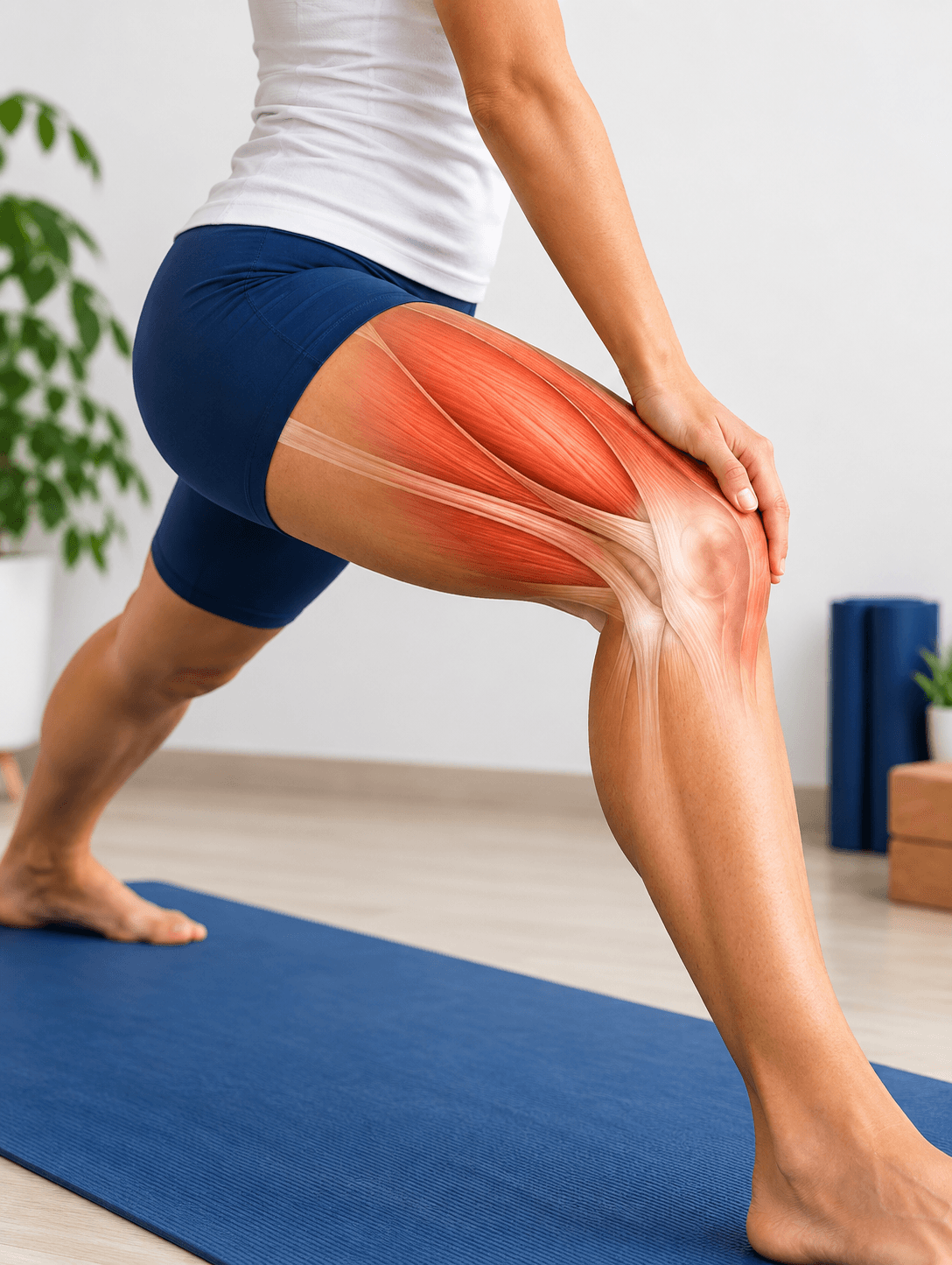
Real Problem: Why Do Your Knees Feel Less Supported?
Your knees work through countless movements every day—walking, climbing stairs, standing up, sitting down and changing direction. When the muscles around the knee are not adequately conditioned, everyday movement can feel less stable or more demanding.
The quadriceps, the group of muscles at the front of the thigh, play an important role in extending the knee and controlling movements such as squatting and stepping. Long periods of inactivity, reduced strength training, poor movement habits or simply an inconsistent routine can make it harder to maintain lower-body strength.
The goal is not to train as hard as possible. The better question is: “How can I build useful leg strength with controlled, appropriate movement?”
Useful Information: Why Quadriceps Strength Matters
Quadriceps strength is one part of healthy lower-body function. A balanced practice can also include hip strength, calf strength, balance, mobility, coordination and controlled breathing.
• Controlled knee and hip movement
• Lower-body strength and stability
• Balance and coordination
• Mobility and movement awareness
• Functional strength for everyday activities
• Consistency without unnecessary intensity
Strong muscles do not guarantee pain-free knees, and exercise should be adapted to the individual. If you have persistent knee pain, swelling, a recent injury or a diagnosed condition, seek appropriate healthcare guidance before starting a new strengthening routine.
Evidence & Expertise: Why Controlled Strength Training Matters
Good movement is about more than completing a repetition. Technique, range of motion, tempo, breathing and individual ability all influence how an exercise feels and how safely it can be performed.
For example, two people may both want stronger legs, but one may be comfortable with a full squat while another may need a smaller range of motion or additional support. A personalized approach helps match the exercise to the person's current ability rather than forcing a one-size-fits-all routine.
5 Practices to Build Stronger Quadriceps and Better Knee Support
1. Chair Squats
Stand in front of a sturdy chair with feet about hip-width apart. Slowly bend your knees and hips as if you are going to sit, lightly touch the chair, then stand back up. Keep the movement controlled and use a comfortable depth.
Practice guide: Start with 2 sets of 8–12 repetitions. Use the chair for confidence and control.
2. Wall Sit
Stand with your back against a wall and walk your feet slightly forward. Slide down only as far as comfortable, keeping your torso supported by the wall. Hold the position while breathing steadily.
Practice guide: Start with 2–3 holds of 15–30 seconds. Increase the hold gradually rather than forcing a deep position.
3. Step-Ups
Use a stable, low step. Place one foot on the step and press through that leg to rise, then step down with control. Keep your knee tracking comfortably in line with your foot.
Practice guide: Start with 2 sets of 6–10 repetitions per side. Choose a lower step if balance or control is difficult.
4. Supported Split
Squats Take a comfortable staggered stance and hold a wall or sturdy support. Lower your body slowly, keeping your front foot planted, then press through the floor to return to standing.
Practice guide: Start with 2 sets of 6–10 repetitions per side. Keep the range of motion comfortable.
5. Straight-Leg
Raises Lie on your back with one knee bent and the other leg extended. Tighten the thigh of the straight leg and slowly lift it to a comfortable height. Lower it with control without dropping the leg.
Practice guide: Start with 2 sets of 8–12 repetitions per side. Focus on a smooth lift rather than a high lift.
Practical Tips: Make Your Strength Routine More Effective
Tip 1: Start With Your Current Ability
Choose a version of each exercise that you can perform with control. You do not need to match someone else's depth, speed or repetitions.
Tip 2: Prioritise Technique Over Repetition Count
A slower, controlled movement is often more useful than rushing through a larger number of repetitions. Keep your breathing steady.
Tip 3: Progress Gradually
When an exercise becomes comfortable, increase repetitions, hold time or resistance gradually. Avoid making several changes at once.
Tip 4: Train the Whole Lower Body
Quadriceps strength is only one part of lower-body function. Include appropriate hip, hamstring, calf, balance and mobility work for a more balanced routine.
Tip 5: Be Consistent
A realistic routine performed regularly is easier to maintain than an intense workout that leaves you too tired or uncomfortable to continue.
Common Mistakes That Can Limit Progress
Mistake 1: Going Too Deep Too Soon
Better approach: Start with a comfortable range of motion and gradually build capacity.
Mistake 2: Letting the Knees Collapse Inward
Better approach: Keep the knee tracking comfortably in the same general direction as the foot.
Mistake 3: Moving Too Quickly
Better approach: Use controlled repetitions, especially during the lowering phase.
Mistake 4: Ignoring Pain Signals
Better approach: Stop or modify an exercise if it causes sharp, worsening or unusual pain, and seek professional guidance when appropriate.
Mistake 5: Training Only One Muscle Group
Better approach: Build a balanced lower-body routine instead of focusing exclusively on the quadriceps.
FAQ:
Quadriceps Strength & Knee Support Can strong quadriceps help support the knees?
Yes. The quadriceps contribute to knee movement and lower-body control. Building overall leg strength can support functional movement, although it does not guarantee that knee pain will disappear.
Do I need gym equipment to train my quadriceps?
No. Several effective exercises can be performed with body weight and simple household support such as a sturdy chair or wall.
How often should I practise these exercises?
There is no universal schedule. Begin with a manageable routine and allow adequate recovery. Consistency and gradual progression are more important than doing as much as possible at once.
Can beginners do these exercises?
Yes, when the exercises are adapted to their current ability. Beginners should prioritise stability, comfortable range of motion and controlled technique.
What if I already have knee pain?
Do not use strengthening exercises as a substitute for assessment. Persistent pain, swelling, significant instability, recent injury or a diagnosed condition should be evaluated by an appropriate healthcare professional.
Can yoga complement quadriceps strengthening?
A personalised yoga practice can complement strength work by incorporating controlled movement, mobility, balance, breathing and body awareness. The exact practice should match the individual's goals and physical needs.
A More Personal Approach to Wellness
Stronger movement does not have to begin with an extreme workout. It can begin with a few well chosen movements, performed with attention and repeated consistently.
Your current strength is different. Your mobility is different. Your schedule is different. So your practice should be built around what is appropriate for you.
A personalised wellness approach can bring together strength, mobility, balance, breathing and movement awareness to create a routine that feels realistic and sustainable.
Soft CTA
do not need another extreme workout.
Your knees They may simply need consistent, appropriate movement and stronger support from the muscles around them. Explore a personalised practice with Pure Lifestyle Yoga and take your next step toward stronger, more confident movement.
Enjoy writing like this?
Considered pieces on practice and wellbeing — never a marketing blast.