

21 May 2026 · 4 min read
Biomechanics 101: How Correct Knee Tracking Protects Your Joints in Yoga
By Pure Lifestyle Yoga
Sometimes the Smallest Misalignment Creates the Biggest Discomfort
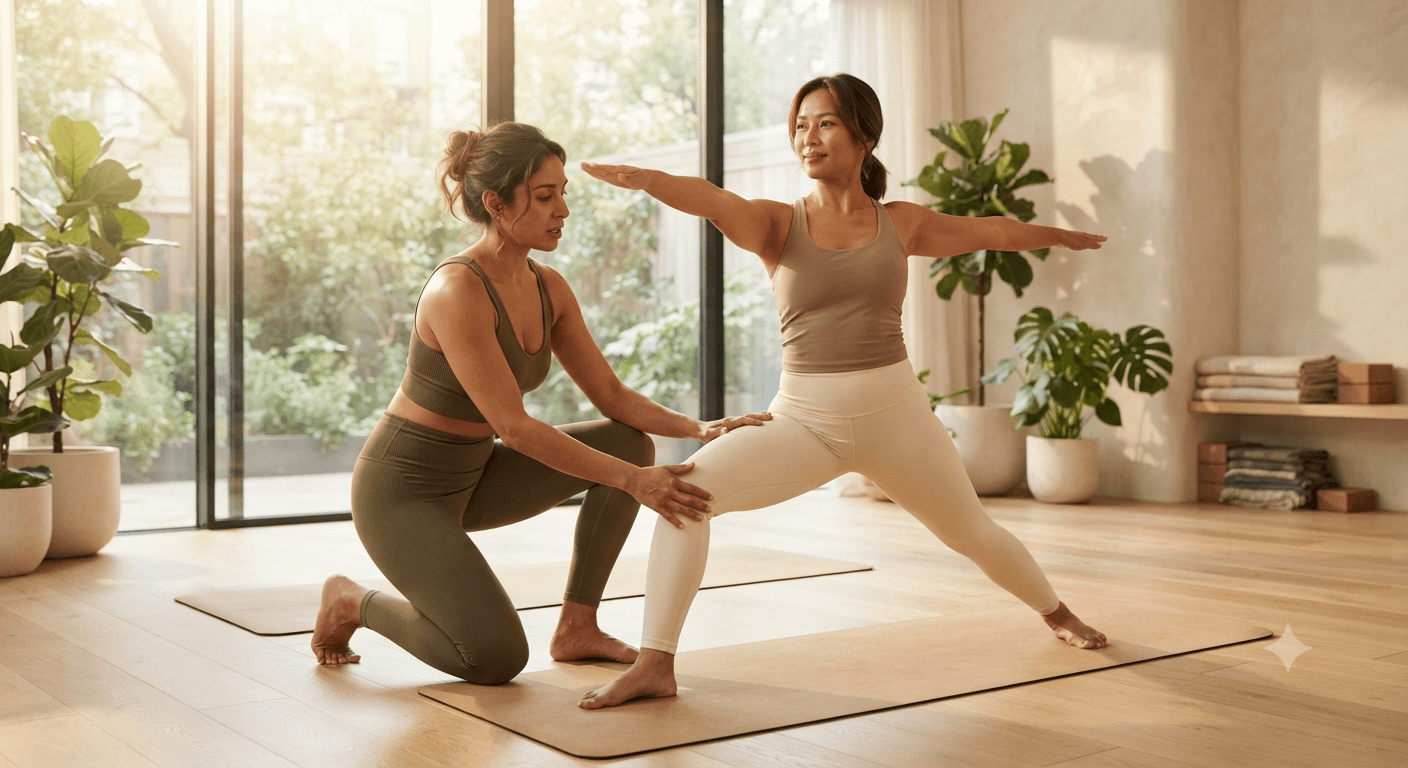
Imagine this. You're in the middle of a yoga class, moving into Warrior II. You bend your front knee, stretch your arms wide, and settle into the pose. From the outside, everything looks perfect. But inside, your knee feels slightly uncomfortable. It isn't painful enough to stop practicing, yet it doesn't feel completely right either.
Most of us respond in the same way—we assume we need stronger knees, more flexibility, or simply more practice. So, we continue pushing through the discomfort, hoping it will disappear over time.
Interestingly, that's rarely the real issue.
At Pure Lifestyle Yoga, we often meet students who believe their knees are the problem. But after observing the way they move, we discover something entirely different. In many cases, the discomfort isn't coming from weak knees at all. Instead, it's the result of subtle movement patterns that have developed over years—while sitting at a desk, climbing stairs, standing with uneven weight, or simply moving without awareness.
Yoga has a beautiful way of revealing these patterns. It doesn't create them; it simply brings them into the light. And one of the most important patterns it reveals is something called knee tracking.
What Is Knee Tracking, and Why Does It Matter?
The term knee tracking may sound technical, but the idea is surprisingly simple. Whenever you bend your knee—whether you're walking upstairs, sitting down in a chair, or practicing Warrior Pose—your knee should naturally move in the same direction as your foot.
Think of your leg as a railway track. The hip is one station, the ankle is another, and the knee travels smoothly between them. As long as it stays on its track, movement feels balanced and efficient. But if it starts drifting inward or outward, unnecessary pressure builds within the joint.
The body is incredibly intelligent. Whenever one part isn't doing its job properly, another part quietly compensates. Over time, those compensations may lead to stiffness, instability, or discomfort.
This is why yoga teachers pay so much attention to alignment. Alignment isn't about making a pose look beautiful—it is about helping your body move in a way that supports long-term joint health.
Simple Ways to Protect Your Knees During Yoga
You don't need to memorize complicated anatomical terms.A few mindful habits can make every practice safer and more enjoyable.
Build Your Foundation
Healthy movement begins with the feet.
Spread your toes gently.
Feel your weight distributed evenly.
Stable feet create stable knees.
Let Your Hips Help
Strong hips reduce unnecessary pressure on the knees.
Many balancing poses and standing postures naturally strengthen these muscles over time when practiced correctly.
Why One-Size-Fits-All Yoga Doesn't Always Work
If you've ever attended a large yoga class, you've probably noticed something interesting. Everyone is practicing the same pose, but no two bodies look exactly alike.
That's because every person's body tells a different story.
Age, previous injuries, work habits, mobility, muscle strength, and even bone structure influence how we move. What feels comfortable for one person may feel completely different for another.
This is why personalized instruction matters.
At Pure Lifestyle Yoga, we don't simply guide students through poses. We observe how they move, identify subtle compensations, and offer adjustments that suit their unique body.
Sometimes the change is as simple as widening the stance by a few centimeters.
Sometimes it's encouraging a student to bend slightly less.
Sometimes it's helping them activate muscles they didn't even realise they had.
These small refinements often transform not only the yoga practice but also the way people walk, climb stairs, stand, and move throughout daily life.
Yoga Is About Movement That Lasts a Lifetime
Many people begin yoga hoping to become more flexible.
Flexibility is wonderful, but it isn't the ultimate goal.
The real goal is moving well for years to come.
Healthy knees make morning walks easier. They make climbing stairs more comfortable. They support weekend adventures, long working days, travel, and the countless ordinary moments that make up life.
This is why alignment matters so much. Every mindful adjustment you make today is an investment in the way your body will support you tomorrow.
Yoga Is About Movement That Lasts a Lifetime
Many people begin yoga hoping to become more flexible.
Flexibility is wonderful, but it isn't the ultimate goal.
The real goal is moving well for years to come.
Healthy knees make morning walks easier. They make climbing stairs more comfortable. They support weekend adventures, long working days, travel, and the countless ordinary moments that make up life.
This is why alignment matters so much. Every mindful adjustment you make today is an investment in the way your body will support you tomorrow.
At Pure Lifestyle Yoga, we believe yoga isn't about achieving the perfect pose. It's about understanding your body well enough to move with confidence, comfort, and awareness.
Because when movement becomes intelligent, it also becomes sustainable.
And that's where true wellness begins.
At Pure Lifestyle Yoga, we believe yoga isn't about achieving the perfect pose. It's about understanding your body well enough to move with confidence, comfort, and awareness.
Because when movement becomes intelligent, it also becomes sustainable.
And that's where true wellness begins.
Enjoy writing like this?
Considered pieces on practice and wellbeing — never a marketing blast.